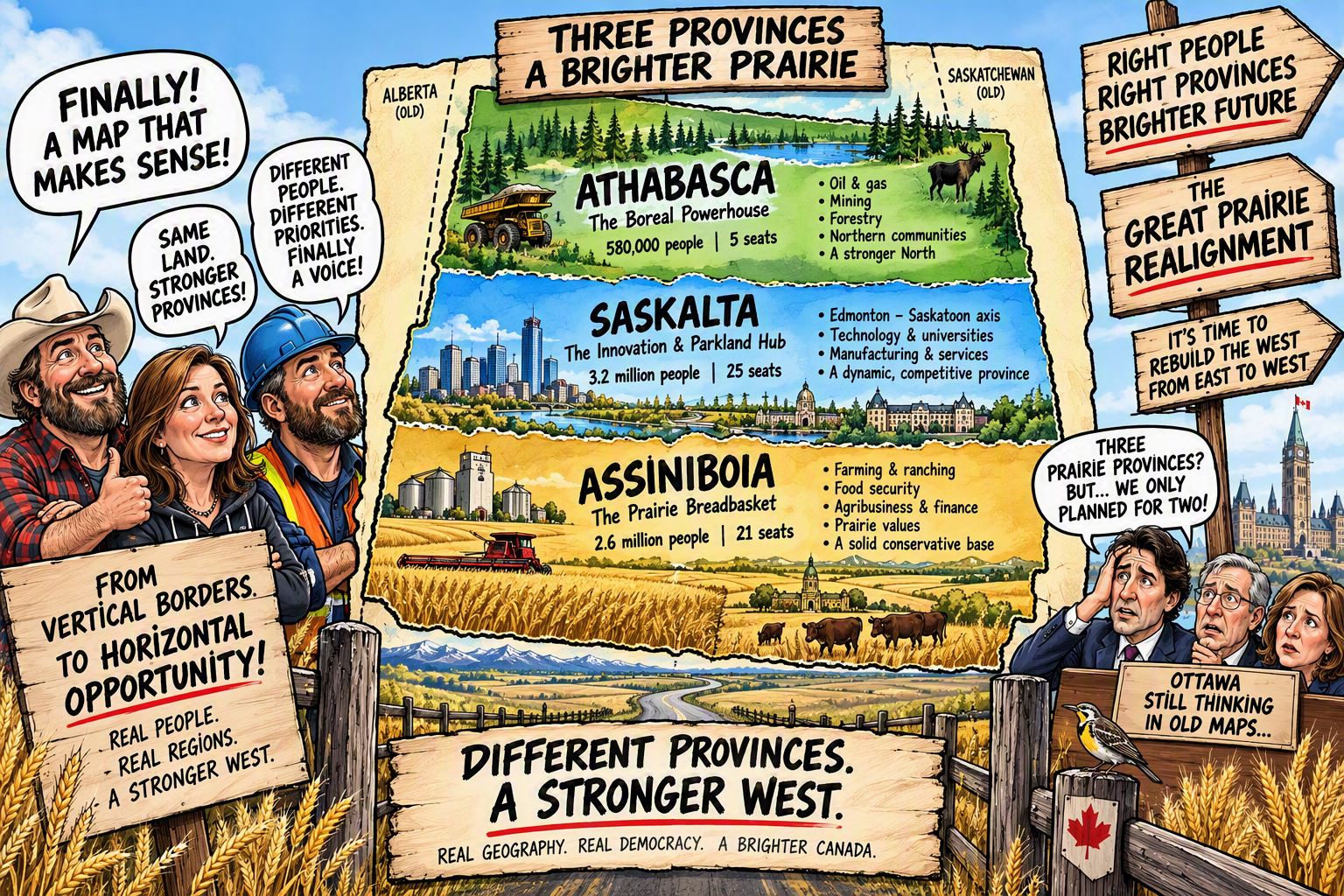
The Great Prairie Realignment:
Why It’s Time to Rebuild the West From East to West
For decades, political conversations in Western Canada have followed a predictable, exhausting loop. When frustration peaks, the immediate reaction is to look eastward toward Ottawa and blame the federal map. Proponents of Western alienation argue that the system is structurally broken, forcing distinct economic and social cultures into a single political box called “The West.”
But perhaps the problem isn’t just the map of Canada. Perhaps the problem is the map of the prairies themselves.
We treat Alberta and Saskatchewan as two massive, vertical blocks bounded by arbitrary lines drawn on a map over a century ago. Yet, a farmer in southern Alberta has far more in common with a rancher in southern Saskatchewan than they do with an oil-field worker in Fort McMurray or a tech startup founder in Edmonton. By forcing vast, economically diverse, and politically distinct regions into just two massive provincial buckets, we have created internal political gridlock that locks out minority voices and stalls economic focus.
It is time for a radical rethink: The Great Prairie Realignment. We should dissolve the vertical border between Alberta and Saskatchewan, divide the combined territory horizontally into three distinct bands, and create three brand-new provinces tailored to their actual geographic, economic, and cultural realities.
Together, this proposed realignment would cleanly redistribute a powerhouse population of 6.38 million people and 51 House of Commons seats based strictly on shared regional interests, giving birth to three proud new provinces: Assiniboia, Saskalta, and Athabasca.
One Horizon, Three Economic Identities
By rebuilding the prairies horizontally, we unlock three highly focused, cohesive provinces that finally reflect how people actually live, work, and vote:
- The Province of Assiniboia (The Prairie Breadbasket): Spanning from the foothills of Calgary across to Regina, this province revives the historic 19th-century name of the regional district before the 1905 borders were drawn. Housing roughly 2.6 million people and commanding 21 federal seats, Assiniboia would be an agricultural and financial powerhouse. Anchored by two major corporate and agricultural hubs, its mandate would be hyper-focused on dryland farming, ranching, irrigation, and traditional prairie values. Politically, it would form a cohesive, reliably conservative bedrock.
- The Province of Saskalta (The Innovation & Parkland Hub): This would become the economic and demographic engine of the West, linking the booming Edmonton-Saskatoon axis with a massive population of 3.2 million people and 25 federal seats. Bearing a traditional Canadian portmanteau that honors the union of the central belts, Saskalta would group the parkland belt, high-tech sectors, major universities, and manufacturing centers together. It would form a highly dynamic, politically competitive province where urban progressives and moderate rural voters balance each other out, ending the frustration of the “one-party province” mentality.
- The Province of Athabasca (The Boreal Powerhouse): Stretching from Grande Prairie through Fort McMurray to the northern reaches of Saskatchewan, this province takes a name already deeply embedded in our geographic history to home 580,000 residents and hold 5 highly influential federal seats.
The Asset Problem: What Happens to SaskTel and AIMCo?
Skeptics will ask how these newly formed provinces could handle massive inherited provincial assets. The answer lies in transforming these institutions into cross-provincial tools of scale, rather than scrapping them.
Take SaskTel, Saskatchewan’s prized public telecommunications Crown corporation. It generates $1.4 billion in operating revenue and delivers over $104 million in net income back to the public. Under the new map, dividing SaskTel would destroy the crown’s competitive scale. Instead, SaskTel should be expanded into a joint-Crown corporation owned equally by Saskalta and Assiniboia. Operating across a broader customer base from Calgary to Regina, a unified public telecom could fund massive rural broadband infrastructure across the central and southern farm belts with even greater financial muscle.
On the investment side, Alberta’s institutional heavyweight is AIMCo, which manages a staggering $210 billion in assets under management covering public pensions and the Heritage Savings Trust Fund. Dividing a multi-billion dollar investment fund would break its global market leverage. The logical solution is to transition AIMCo into an independent, multi-provincial asset manager. Saskalta and Assiniboia would maintain their respective shares of public pension portfolios within the fund, while the newly enriched province of Athabasca could use AIMCo’s institutional scale to manage a brand-new sovereign wealth fund built directly on northern mineral and energy royalties.
The Energy Divide: From Extraction to Corporate Power
The most radical shift in this realignment belongs to the lifeblood of the prairie economy: oil and gas. By rebuilding the map horizontally, we break up a centralized system and distribute energy wealth according to its actual regional functions, creating a highly efficient supply chain across three distinct jurisdictions.
Under this model, the province of Athabasca instantly transforms into a global energy superpower. By inheriting the Athabasca oil sands, the heavy oil of Cold Lake, and the conventional gas fields of the Peace River country, this new northern province—with a population of just 580,000—would command one of the highest per-capita resource revenues on Earth. Unshackled from the political friction of southern urban centers, Athabasca’s legislature can focus purely on upstream extraction, environmental reclamation, and heavy industrial partnerships with northern Indigenous communities.
Further south, the province of Saskalta becomes the brain and refinery of the operation. It would inherit the massive industrial refining heartland northeast of Edmonton, the light oil fields of Red Deer and Lloydminster, and the traditional patch around Kindersley. Saskalta’s mandate would center on value-added processing, upgrading, pipeline logistics, and engineering innovation, acting as the critical midstream link that turns raw northern product into market-ready energy.
Finally, the province of Assiniboia secures the corporate and financial crown. While it holds plenty of conventional production in southern Alberta and the rich Bakken shale formation of southeastern Saskatchewan, its true energy asset is Calgary—the undisputed headquarters of Canadian energy capital. Assiniboia’s focus would be corporate regulation, investment markets, and international pipeline trade routes.
To ensure stability, these three new provinces would be bound by a Trans-Prairie Resource Accord. Because the north cannot export its oil without the central refineries and southern corporate offices, a negotiated royalty-sharing agreement would keep the entire region economically balanced, proving that the energy sector works best when its legal borders match its operational realities.
Maximum Representation, Minimum Bureaucracy
The beauty of the horizontal realignment is its structural efficiency. We already have the capital infrastructure.
The existing, historic Legislative Assembly in Regina sits squarely in the new province of Assiniboia and is ready to serve as its capital. The Legislative Assembly in Edmonton sits perfectly within Saskalta to govern the innovation belt. We would only need to construct or designate one new legislative building in a northern hub like Grande Prairie or Fort McMurray to give Athabasca its long-overdue home.
In Ottawa, the impact would be revolutionary. Instead of two massive provinces whose diverse federal ridings are often painted with a single, sweeping political brush, three distinct provinces would head to Parliament. Assiniboia and Athabasca would send strong, focused conservative and populist blocks, while the highly populated Saskalta would become one of the most exciting electoral battlegrounds in the country. Northern communities would secure a permanent, constitutionally protected minimum baseline of MPs and Senators, ensuring their massive landmass is never ignored.
The Path Forward: Parallel Consultative Referendums
A transformation this profound cannot be dictated from above; it requires clear democratic direction from the electorate. To initiate this process within Canada’s constitutional framework, the governments of Alberta and Saskatchewan would need to hold parallel consultative referendums on the exact same voting day.
Because referendums in Canada are non-binding plebiscites that advise rather than replace the legislature, a successful vote would not automatically alter any borders or interfere with the role of the Crown.
Instead, a clear “Yes” vote would provide the Members of the Legislative Assemblies (MLAs) with the necessary political guidance to confidently introduce constitutional resolutions. A successful referendum provides the political green light for those assemblies to act.
A clear, two-part ballot would ensure voters can properly advise their governments on both the geographic shift and its economic foundations:
Question 1: The Geographic Realignment
“Should the Legislative Assembly pursue a constitutional amendment to alter provincial boundaries and establish three new provinces—Athabasca (North), Saskalta (Centre), and Assiniboia (South)?”
[ ] YES
[ ] NO
Question 2: The Trans-Prairie Resource Accord
“If the horizontal realignment is pursued, should the governments negotiate a Trans-Prairie Resource Accord to govern shared infrastructure, co-manage assets like SaskTel and AIMCo, and establish a temporary resource-royalty sharing framework between the three new provinces?”
[ ] YES
[ ] NO
By framing this choice as a formal consultation, the Great Prairie Realignment respects Canada’s constitution while building the necessary political momentum to rebuild the West from the ground up.
Testing Our Own Maps
Borders are not sacred; they are tools meant to serve the people living within them. If we are willing to question the constitutional fabric of Canada, we must first be willing to test our own internal boundaries.
The Great Prairie Realignment isn’t about dividing the West—it’s about organizing it so that it can finally succeed. By matching our governance to our actual geography, we can end the internal political warring, give our distinct economies a dedicated voice, and build a truer, more accurate democracy right here at home.
Footnotes:
1. Please note, this is not about partitioning. Provinces have a constitutional right to consent to CHANGE THEIR BORDERS, necessarily within Canada. The British North America Act, 1871 empowered the Parliament of Canada to increase, diminish, or alter the limits of any province.
2. Section 3 explicitly stated that this territorial alteration could only occur “with the consent of the Legislature of any Province of the said Dominion”.
3. The provincial legislature’s consent could be tied to specific terms and conditions agreed upon mutually by the province and the federal Parliament, such as “Trans-Prairie Resource Accord” proposed in the post above.
4. I am referring to the Constitution of 1867, as amended, specifically the amendments of 1871, which cover this matter, because the 1982 constitution was a coup by Trudeau and is illegal, it was not a constitutional amendment. In any case, provinces have a constitutional right to alter their borders.